




On February 23, 2024, soon after Sheikh Hasina came to power in Bangladesh, young journalist Saqlaine Rizve wrote a long news report to address a question that had haunted him for years: The two nations are friendly neighbours. Why, then, do Indian troops so frequently use lethal force along the border?
We had met Rizve in Dhaka in January 2024 after the polls, and he told us that with the BNP boycotting the polls and calling it a farce, and the Supreme Court of Bangladesh keeping the country’s largest Islamist party, the Jamaat-e-Islami Bangladesh, out of the fray, it was a given that Hasina would stomp back to power. But why were the borders still bleeding, he asked.
Rizve said it was not safe to report on an issue as controversial as border killings, but he didn’t care for his safety. The report came out on February 23, 2024, six months before Sheikh Hasina’s fall.
Rizve wrote of a typical day in April 2018, usually the hottest month of the year in Bangladesh. Rasel Miah, a 14-year-old boy from Phulbari Upazila in Kurigram, accompanied his father, Md Hanif Uddin, a farmer, to their field near the Bangladesh–India border, just beyond the 150-yard No Man’s Land. As the sun began to set, Miah and his father were wrapping up their work to go home. Miah was holding on to the rope of their cow when out of nowhere two members of India’s Border Security Force (BSF) rushed towards them.
“I was dressed in a lungi (a traditional garment worn by men in Bangladesh and various Asian countries) along with a T-shirt while holding our cow’s rope. As they started to run to us, I ran with our cow. At one point, I jumped into a river, and suddenly, a BSF member fired chita guli [rubber bullets],” Miah, now 20 years old and studying philosophy at Uttar Bangla College in Lalmonirhat, another northern bordering district of Bangladesh, told Rizve.
“For a few minutes, I couldn’t see anything, and to this day, I still don’t see with my right eye,” Miah said.
“They claimed I was cutting the barbed wire fence. How could a 14-year-old boy cut the barbed fence of an international border? After returning home, the people who were working alongside us in the field mentioned that the BSF jawan appeared to be drunk at that time.”
Rizve wrote that there was extensive media coverage of the encounter and Miah’s injury inflicted by the BSF officer. Following a diagnosis at a nearby hospital, Miah’s family transferred him to Dhaka, where he underwent a month-long examination at a government hospital. Miah never got the vision back in his right eye.
Rizve wrote that Bangladesh and India share a 4,096-kilometre border, the fifth-longest in the world. The border separates the six divisions of Bangladesh and the Indian states of Assam, West Bengal, Mizoram, Meghalaya and Tripura. “The border has been a source of various issues, such as smuggling, illegal immigration, cross-border terrorism, and human rights violations. Despite the friendly political relations, the border area is fraught with tension – and violence,” he wrote.
In his report, Rizve quoted Ain o Salish Kendra, a human rights organisation in Bangladesh, to say that between 2013 and 2023, a total of 332 individuals were reported killed by the BSF near the Bangladesh–India border, an average of 30 people per year.
“And that estimate is on the low side. Another rights group reported that at least 1,236 Bangladeshis were killed and 1,145 were injured in shootings by the BSF between 2000 and 2020. According to Dr Mohammad Abdur Rab’s book Bangladesh: Geography, Geopolitics, and Environment, a total of 206 Bangladeshi civilians were reported killed by the BSF from 1990 to 1999,” he wrote.
The report said that smuggling activities were prevalent along the border, involving the illegal transportation of cows, drugs, arms and other goods. “However, the use of lethal weapons against suspected smugglers raises serious concerns. There have been numerous cases where innocent individuals were shot by [the] BSF or abducted, actions that blatantly defy both legal and moral principles,” Rizve wrote.
“Accepting that smuggling is a crime, law enforcement agencies are required to apprehend the criminal, produce him before a court, and it would be for the judge to decide what punishment was to be administered.”
Rizve’s report then quoted Md Touhid Hossain, former foreign secretary of Bangladesh, as saying the “high leadership of India is on record saying that as long as ‘crimes’ along the border continue, border shootings will also continue. Notably, the records indicate that the BSF intentionally shoots to kill. Non-lethal injury is comparatively rare. In my view, and I know many who also feel the same way, this is a phenomenon that is completely unacceptable. There is no reason why this should be a regular feature at the border between two countries that are supposedly role models for bilateral relations,” Hossain added.
Rizve then went on to narrate what his investigation on border killings threw up as perhaps the most notorious case that occurred on January 7, 2011, in the Anantapur border area in Kurigram. “On that day, a 14-year-old girl’s body was left hanging on the barbed wire fence that separates the two countries. The girl was Felani Khatun, a Bangladeshi who lived with her parents in Assam, a state of India bordering Bangladesh. She was supposed to don a red saree and jewels, traditional Bengali wedding attire, and sit in the wedding hall on January 8. To that end, she and her father, Md Nurul Islam Nuru, were illegally crossing the border with the help of brokers.
“Her father crossed the fence successfully. Then it was Felani’s turn. When she climbed to the fence with a ladder, she was shot by a BSF soldier. Felani was left hanging on the fence for about four hours. During that time, she was still alive; villagers reported hearing her pleas for water and assistance, yet fear kept them from approaching. Gradually, Felani succumbed to her injuries and took her last breath.
“Thirty hours later her dead body was brought back, bound to a bamboo pole with her hands and feet restrained. She wore a white shroud instead of a red saree. The image of her body – first alive, then dead – hanging on the fence is enough to make many question the friendship between Bangladesh and India. And Felani was not the first or the last Bangladeshi civilian to be killed along a border that is among the world’s deadliest, despite linking two friendly nations.
“Amidst public outcry in Bangladesh, Amiya Ghosh, a BSF soldier, faced charges. Despite a trial and retrial, he was finally acquitted on September 6, 2013, citing inconclusive evidence. Nuru, Felani’s father, criticised the BSF court’s decision as a mockery of justice.”
Rizve wrote that not only did the BSF kill Bangladeshi civilians, but there were also reports of civilians being abducted and tortured by the Indian border force every year. “From 2013 to 2023, nearly 500 civilians were abducted. In 2013 alone, 175 were abducted; among them, only 49 were brought back by the BGB. The other 126 are still missing.
“According to a research paper, ‘Bangladesh–India Border Crisis: Nature and Remedy’ by Dr Saleh Shahriar, an assistant professor of history at North South University, in addition to instances of fatal shootings, Bangladeshi citizens have reported enduring various forms of torture inflicted by the BSF. These include gunshot wounds, hacking wounds, restraining individuals by tying their hands and feet before submerging them in water, using pliers to pull out nails, bayonet stabbings, ear mutilation, physical beatings, burning the entire body or specific body parts with cigarettes. Even more severe actions include burning, maiming, genital mutilation, eye gouging, hanging bodies on barbed wire, and instances of rape,” he wrote.
Rizve’s report shook Bangladesh and confirmed something the youth of the country already believed. “The ‘friendship’ between Bangladesh and India that Sheikh Hasina flaunted was a beautiful lie. If you care to check Bangladesh’s borders with India, it wasn’t even beautiful; it was just a lie. We won’t live that lie any longer,” Sheikh Iklas Audy told us.
While the anger in Audy is palpable, a senior leader in his party, Amir Khasru Mahmud Chowdhury, a member of the BNP’s International Affairs Committee, told us Bangladesh still wanted friendly ties with India. “Irrespective of who comes to power and who loses it, India and Bangladesh cannot afford to not be friends. Mutual respect, bilateral peace and promotion of the economy on both sides have to be our joint objectives. You can’t change your neighbour, can you?” Chowdhury, 74, says.
We called Audy again. Did the youth of Bangladesh see India as an enemy country? “No! Most of us love Indians. Have you forgotten the boat ride we took along the Madhumati River the last time all of you were in my village? The walk inside the Kans grass forest, the early morning bike rides on unpaved streets to the local bazaar to haggle and buy the morning’s fresh catch of river fish? We can so easily go back to being friends again, the youth of the two nations. Please do one thing for us to trust you again.”
And what is that?
“Send Sheikh Hasina back. She needs to face the law for her crimes against humanity,” Sheikh Iklas Audy said.
Bangladeshi political analyst Maruf Mullick has written that since Bangladesh’s independence, India has wanted to control the country. “It has continuously killed Bangladeshis along its border, it has withdrawn water from its rivers upstream to keep Bangladesh under pressure and ensure its own interests. It has interfered in one election after another. But if India halts the border killings, shares river water on the basis of bilateral talks, refrains from interference in Bangladesh’s internal affairs, then the anti-Indian sentiment will automatically dissipate and the security threats will drop,” he said.
Mullick also pointed fingers at the Indian media for fermenting anti-India sentiments in Bangladesh. “The attitude of a certain group of Indian media and politicians indicates that they are simmering in fury. Are they furious because Sheikh Hasina was toppled from power? Perhaps Sheikh Hasina had given all to India with open arms. Her fleeing has affected Indian interests. But India should control its behaviour concerning an independent, sovereign country’s domestic affairs,” he wrote.
Popular Bangladeshi political analyst and atheist blogger Asad Noor has a different view. Noor told us over a call from Canada that while all of these aspects may well be true in parts, they hid a deeper truth: the unmissable Islamization of a society built on secular values. “1971 was too long ago. The current generation has grown up on a potent diet of Islamism. The influence of Islamic preacher Zakir Naik on South Asian societies cannot be overlooked. Naik showed you that you can put on a sharp suit, speak clipped English and yet be an Islamist. The angry Bangladeshi youth has discarded the values of a secular society for an Islamic one with sprinklings of modernity,” Khan says.
According to Noor, the Islamisation of Bangladeshi youth is evident when young leaders of the “freshly-minted political party NCP comfortably share space with the leaders of the Jamaat-e-Islami Bangladesh”. “Not all but a big chunk of Bangladeshi youth has embraced the idea of Islamic nationalism. This makes it imperative for them to invent an enemy. And that enemy is Hindu-majority India, a country that stood behind Bangladesh during the 1971 War of Independence, trained its guerrilla army, the Muktibahini; it is today an enemy for all seasons. India hate has become a prerequisite for the neo-nationalist. Couched within it is Hindu hate, and that hate is visible to the world now by the silence of the Bangladeshi youth to the atrocities against the Hindu Bangladeshi.
They cry for Palestine, take out processions in support of Gaza but do not shed a tear for their fellow citizen who prays to Hindu gods when she is raped or killed by Islamists. Thus, it is easy for them to hate India, a country bigger, stronger and overwhelmingly Hindu!”
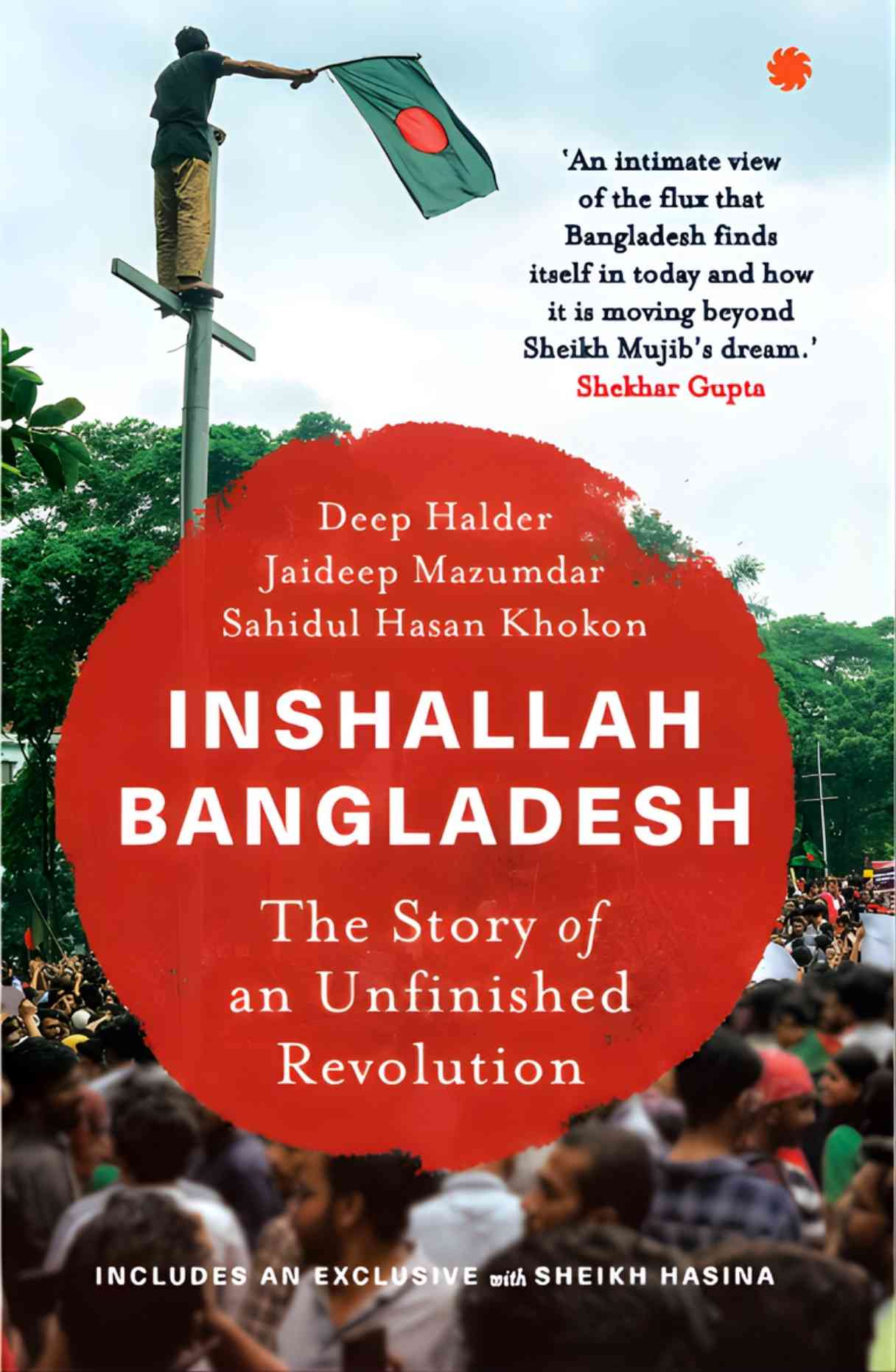
Excerpted with permission from Inshallah Bangladesh: The Story of an Unfinished Revolution, Deep Halder, Jaideep Mazumdar, and Sahidul Hasan Khokon, Juggernaut.
